










 Kontaktieren Sie uns
 Vertriebspartner suchen


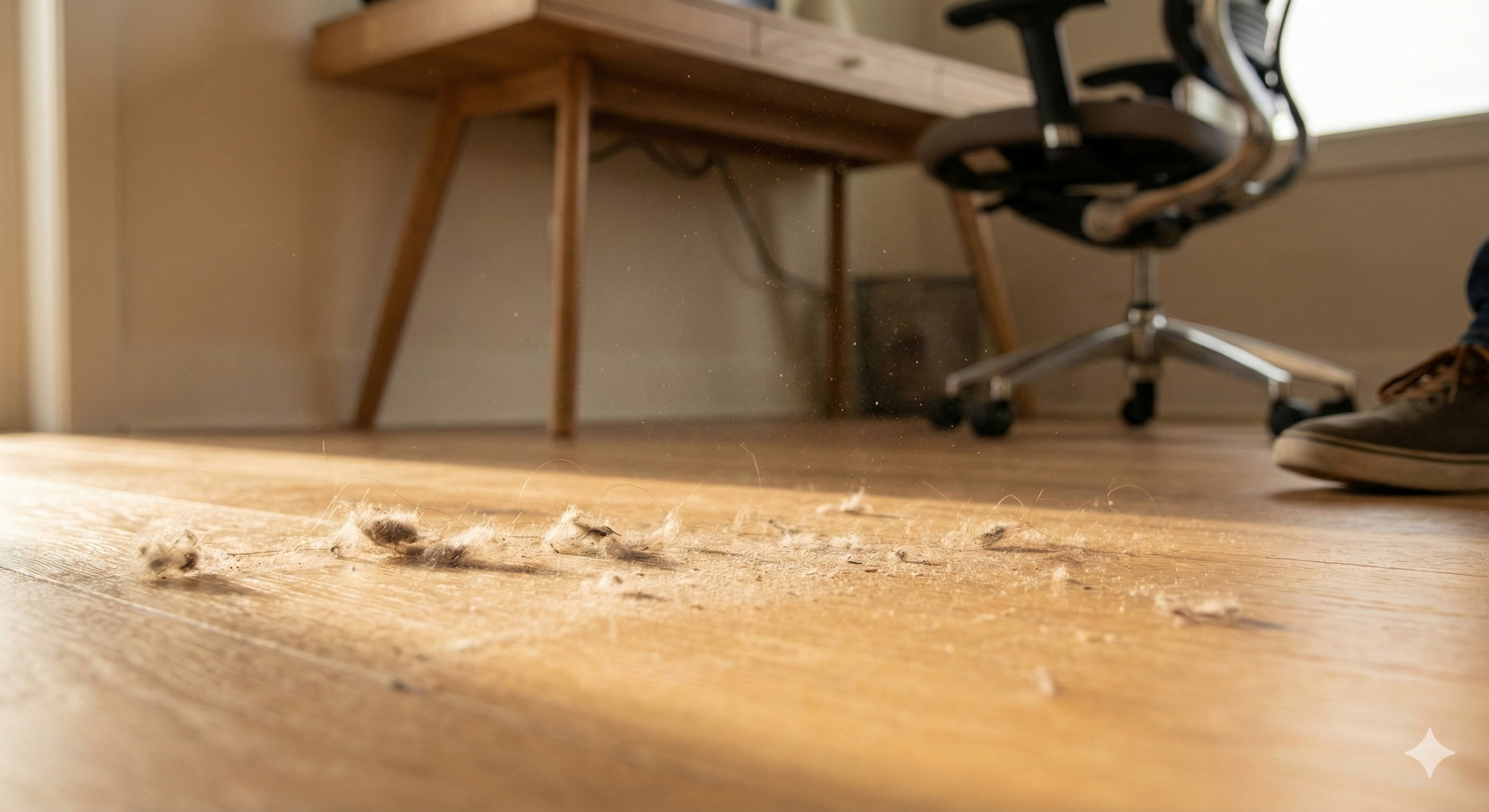
Dust is the silent companion of our everyday lives. No sooner have you cleaned the shelves or the office floor than a gray film seems to settle again just a few hours later. It's a losing battle. But to fight this battle more effectively, you first have to understand your enemy.
In this article we explain how dust is formed , what it consists of and why it is often more than just a visual problem.
What exactly is dust?
Before we answer the question "Where does dust come from?", let's look at its composition. Dust is not a single substance, but a complex mixture of organic and inorganic particles.
In a typical office environment, dust usually consists of:
- Skin flakes: Humans lose about 10 grams of skin per day – this is the main source of house dust.
- Fibers: Abrasion from clothing, carpets and upholstered furniture.
- Pollen and spores: These are brought in from outside through windows and ventilation systems.
- Rock flour and road abrasion: particles that we carry into buildings on our shoes.
How is dust formed? The process of accumulation
The answer to the question "How is dust created?" is actually a story about friction and movement.
- Abrasion: Walking on carpets or moving chairs causes tiny fibers to be released.
- Electrostatics: Many surfaces in the office (monitors, plastic housings) attract particles through static charge.
- Air circulation: Dust particles are so light that they are stirred up by the slightest movement (or by the air conditioning). As soon as the air calms down, they sink to the ground.
Special feature: Dust in the office
In commercial spaces, dirt often has a different quality than at home. Dust in the office is caused by additional factors:
- Paper abrasion: Fine paper fibers are created by printers, copiers, and the daily handling of files.
- Fine dust: Laser printers can emit microscopically small particles that settle on surfaces.
- High turnover: Where many people work, more dust is brought in from the outside and more skin is shed.
Why does the dust never stop?
The main problem is that the sources of dust (people, textiles, outside air) are constantly active. Dust is a byproduct of life and work. Once stirred up, it remains in motion until it is physically removed from the room through effective filtration or cleaning.
If cleaning is only done sporadically, such large deposits of dust accumulate in the corners and carpet fibers that every movement in the room releases a new "dust cloud".
What really helps? Tips against dust in the home
Even in private homes, the fight against dust bunnies is a daily task. Those who want to reduce dust levels in their own four walls can avoid dust with a few simple strategies:
-
Proper ventilation: Use "shock ventilation." If windows are permanently tilted open, pollen and street dust continuously enter the room. Short, vigorous ventilation exchanges the air without allowing too much dirt from outside to settle in.
-
Houseplants as dust traps: Plants like snake plants or spider plants act like natural filters. They increase humidity, which makes dust particles heavier and causes them to sink to the ground more quickly, instead of remaining suspended in the air we breathe.
-
Damp wiping instead of dusting: A duster often stirs up more dust than it catches. Use slightly damp microfiber cloths instead. These bind the particles directly to the cloth.
-
Reduce textiles: Carpets, heavy curtains, and open clothes racks are classic "dust magnets." Those with allergies should opt for smooth surfaces that are easy to clean.
-
Consistency is key: Since we shed skin flakes and fibers daily, the interval is crucial. A single deep clean is less effective than a quick, daily vacuuming of the main traffic routes.
Dust management to avoid dust
Since we cannot prevent dust from being generated , we must optimize how we manage it. In large offices or commercial spaces, the classic "vacuuming once a week" is often insufficient to maintain high air quality and protect equipment (such as servers and PCs) from contamination.
The solution for businesses: Continuous cleaning. This is where modern technology comes in. Instead of waiting for dust layers to build up, autonomous systems ensure a continuous reduction of particles.
Nexaro offers a professional solution: Our Nexaro NR 1700 autonomous robotic vacuum cleaner is specifically designed for commercial use. It doesn't just clean floors once, but can also ensure, through scheduled intervals, that dust doesn't even have the chance to accumulate or be stirred up in large quantities. This keeps the dust concentration in the office consistently low – for a healthier working environment and a sparkling first impression.
