










 Kontaktieren Sie uns
 Vertriebspartner suchen



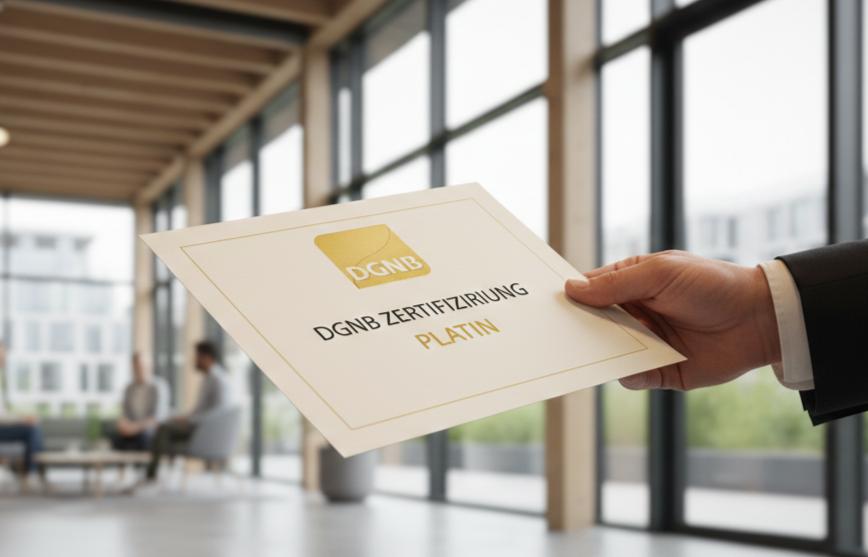
The planning and construction of sustainable properties is now standard practice. But the real challenge begins after the keys have been handed over: during decades of operation. Anyone who wants to obtain or maintain DGNB certification must prove that the building also meets ecological and social requirements in everyday use.
An often underestimated but essential factor here is the management strategy. It is a central component for maintaining value and user satisfaction.
What exactly is DGNB?
Before we go into the details of management, let's clarify the basics: What is DGNB? The abbreviation stands for the German Sustainable Building Council. Its system is regarded worldwide as the ‘global benchmark for sustainability’ because it goes far beyond pure energy efficiency.
Unlike other labels, the DGNB does not certify individual products, but always the entire building or entire city districts over their entire life cycle. Six areas are assessed:
- Ecological quality: How big is the ecological footprint? (e.g. CO2 balance, use of resources).
- Economic quality: Is the building cost-effective in the long term? (e.g. low life cycle costs, stable value).
- Sociocultural & functional quality: How do people feel in it? (e.g. health, accessibility, indoor air quality).
- Technical quality: How good is the technical design? (e.g. fire protection, ease of cleaning).
- Process quality: How sustainably was the building planned and constructed? (e.g. construction site logistics, quality assurance).
- Location quality: Where is the building located? (e.g. public transport connections).
What makes it special: The DGNB certification awards platinum, gold, silver or bronze ratings depending on the overall degree to which these criteria are met. Sustainable cleaning contributes primarily to ecological and socio-cultural quality, as it ensures that value is retained and protects the health of users.
Efficient management at the heart of DGNB criteria
The operational implementation of DGNB certification is the focus of the usage profile for existing buildings and the criterion of ease of cleaning in new buildings. The aim here is to reduce negative environmental impacts and create a healthy environment for users. Anyone who takes a close look at the question ‘What is DGNB-compliant building operation?’ will quickly realise that the quality of management is a decisive factor in determining long-term certification status.
Key areas of action in detail:
- Resource efficiency: Reducing water and energy consumption is essential within the framework of the DGNB. This is achieved through modern processes and precisely controlled technology that minimises the ecological footprint.
- Environmentally friendly substances: Avoiding critical ingredients protects the ecosystem and improves indoor hygiene – an important point for the ecological assessment of DGNB certification.
- Air quality and health: Minimising fine dust directly contributes to the socio-cultural quality of the building and is a core aspect of a healthy working environment according to the DGNB standard.
- Transparency through documentation: Fact-based evidence of cleaning intervals and consumption is mandatory for every DGNB certification audit in order to provide measurable proof of sustainability.
Technological innovation as a supporter
Data-based approaches are becoming increasingly important in order to implement the demanding requirements for DGNB certification in an economical and measurable way.
Automated solutions can make a valuable contribution here by standardising processes and making them objective. Anyone wondering ‘What is DGNB-compliant working in everyday life?’ will often find the answer in precise technical implementation.
One example of this technological progress is the Nexaro NR 1700. Such systems can support the sustainability goals of a property on a technical level:
- Highly efficient filtering (HEPA-H13) reduces particle pollution in the room – a core aspect of socio-cultural quality.
- Autonomous operation enables precise cleaning, which can optimise resource use compared to conventional methods.
- Digital interfaces provide the data required by the DGNB directly and transparently, which significantly reduces the documentation effort for the audit.
Taking responsibility in operation
Sustainability in building management is a continuous process. It is not about short-term effects, but about a strategy that combines ecological responsibility with economic rationality. Innovative technology acts as a tool to ensure the high standards of the DGNB in everyday life and to protect property values in the long term.
